

 Bulgarian
 Romanian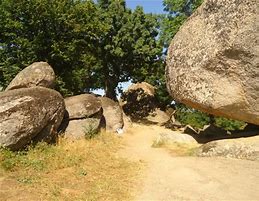
Thracian sanctuary Beglik Tash

Overview
Begliktash or Beglik Tash is located on the Bulgarian Black Sea coast, 5 km from the town of Primorsko and 40 km from the town of Bourgas at the foot of Strandzha Mountain. The site is located near the valley of the river Zigra and is a natural rock ensemble of syenite blocks of different sizes and shapes, formed in situ as a result of spherical weathering of the rocks of the Rosen Pluto and is one of the largest prehistoric megalithic sanctuaries To Bulgaria. The total area - the central part of the site occupies an area of about 8 acres.
The toponym "Beglik Tash" comes from the Turkish language, as "Beglik" means "tax in kind for the feudal lord (bey) in the Ottoman Empire", and "Tash" - stone. Before the Liberation of Bulgaria from Ottoman rule, Bulgarian shepherds from the surrounding Strandzha villages paid their taxes in the form of cattle. The animals were taken to the area where the authorities "collected the tax" on the big stones.
Begliktash is in the immediate vicinity of the ruins of an ancient settlement, which is supposed to be the village of Ranuli, in the vicinity of the Ropotamo reserve, on the ridge of Maslen Nos, about 210 meters above sea level. and 5 km from the town of Primorsko. The site is located on the highest part of Maslen Nos, jutting out into the sea between Sveta Paraskeva Bay and Zigra Bay within the Arkutino hunting farm. The whole megalithic complex is located on an area of 12 decares.
The studied part of the sanctuary consists of a central part and two circles of smaller structures around it with a total area of about 6 decares. The large rock boulders are partially processed by human hands and arranged in unique configurations. Stone circles, pits, baths and steps have been carved into the flat rocks. The apartment building and the cult hearths complement the evidence of human activity on the site. Scholars have found that Begliktash was built by the Thracian tribe of the Scrians, who inhabited this region of Strandzha in antiquity and have the reputation of being one of the best metallurgists in ancient Thrace.
In the second millennium BC. (but probably much earlier) the Thracian tribe of the Scrimians arranged some of the rock fragments to build a kind of sacred space dedicated to the Mother Goddess and her son - the Sun God (Zagreus / Apollo / Dionysus). Many of the large megalithic boulders weigh up to about 100 tons. In the arranged megalithic configurations they have a specific place and are subordinated to specific symbolism.
As a location, it occupies a central place in the region - it is located at the crossroads between the roads connecting the mouth of the river Ropotamo with today's Primorsko, and the ancient town of Ranuli with the port bay of St. Paraskeva. Although high on the slopes of the mountain, the proximity to the sea is a decisive factor in the historical development of this place. Due to its easy access and fame, during the various epochs of its existence it was visited by Thracians, Greeks and Romans.
According to the discovered archeological finds, it is believed that the sanctuary was built in the 14th century BC and functioned until the 5th century AD. In essence, the place performed similar functions as the monasteries perform today.
Archaeologists have developed the following general plan for the location of sites in the sanctuary and their purpose (bearing in mind that at this stage of the study of the sanctuary, the purpose of sites in the sanctuary are subject to proof and scientific justification, as it is scientific interpretation):
1. Entrance - oriented to the southwest, in its undiscovered part continues to the west. It marks the main east-west axis around which the main sites are located.
2. Wedding bed - is a stone shaped like a bed, a kind of pillows are oriented to the east. Rock prints were created to certify the presence of God and to prove his appearance. They are characteristic of the religious symbolism of the ancients and come from ancient times, when the deities did not have their own appearance. However, the relics indicate that there was some kind of unity between them. A wedding bed in the easternmost part of the stone circle is evidence of this. On it, according to archaeologists, the priest and priestess ritually represented the marriage between the Sun God and the Mother Goddess on the night before the summer solstice.
3. Altar - on the monolithic rock are carved pits, which are supposed to be used for religious purposes. In them (according to the interpretation) are poured four sacred liquids - water, wine, milk and vegetable oil.
4. Throne - It is believed that the place was occupied by the High Priest, from where he observed the offerings of gifts and ritual games. The seat carved in a megalithic boulder in ancient times stood on one of the great rocks, but nowadays it lies on the ground - probably destroyed by an earthquake or by treasure hunters.
5. The menhir with a carved step of the Sun God - its length is 0.80 m and its width is 0.40 m. The step is precisely oriented in the east-west direction.
6. Sacred site - the monolithic rock, on which are laid the main elements of the sanctuary depicting various symbols representing the masculine and feminine principles in nature. On it are carved several wells of various shapes, which collect rainwater, according to the interpretation necessary for the rituals performed here.
7. The footsteps of the Mother Goddess - is a testimony to the presence and protection of the Great Goddess.
8. Pleiades - is the name of six pits carved into the rock of the ritual site. Their location is very reminiscent of the constellation Pleiades. (The assumption is by Tsonya Drazheva, who worked on this hypothesis during her lifetime, which has not been proven yet.)
9. Cut stone - was blown up in the 1950s, when the site was used as a quarry and many parts of various sectors of the large-scale sanctuary were destroyed.
10. Apostle Tash (heart-shaped stone) - the huge megalith is supported by only three points, and between them a niche is formed in which you can lie. The sun's rays pass through the niche on June 22 - the longest day of the year, which makes it a kind of calendar. Archaeologists believe that the rolling rock was dragged by the ancients, who later carved a niche under it.
11. A sundial divided the day into six sections. The megalithic composition consists of 6 flat stones located north of Apostle Tash, and its shadow falls on different stones in different parts of the day.
12. Main dolmen (Sacred cave-womb) - is 12 m high and 9 m long. The facility resembles a womb and, according to archaeologists, symbolizes the feminine principle. Its shape confirms the theories that the sanctuary was used to deify the Great Mother Goddess. According to the interpretation, the mystery of the birth of Heros takes place in the womb, who after his appearance, illuminated by the sunrise, is under the arch of the Apostle Tash, welcomed by many worshipers.
13. Labyrinth - according to archaeologists in the peculiar labyrinth of monoliths in the northeastern part of the sanctuary Orphic rites were performed. The labyrinth has two exits - the left, connected with the sacred beginning, and the right, which is associated with the profane in life. Scientists speculate that the maze was used to foretell the future. In order to reach the exits, the initiates had to go through several different trials. One of them is piercing through a narrow gap between the two halves of a megalithic boulder split in two, which is preserved. The rock crevice is 6 m high. and a varying width of about 0.30 m. It is supposed that only righteous and pure people can go through it.
14. Temenos (House of the Oracle) - a building, probably inhabited by the priestly class, which served the sanctuary all year round - dating from the IV century AD. It is believed that with the advent of Christianity in the Roman Empire after the V-VI century AD, the spiritual center moved north to St. Paraskeva Bay, where a Christian monastery was built with the patron Saint Paraskeva.
Recommended
- Underwater Chapel "St. Nicholas the Wonderworker"
- Aqua Park Primorsko
- Urdovitsa Fortress
- Ropotamo Reserve
- Museum of Leo Tolstoy
- Muddy Lagoon Arkutino